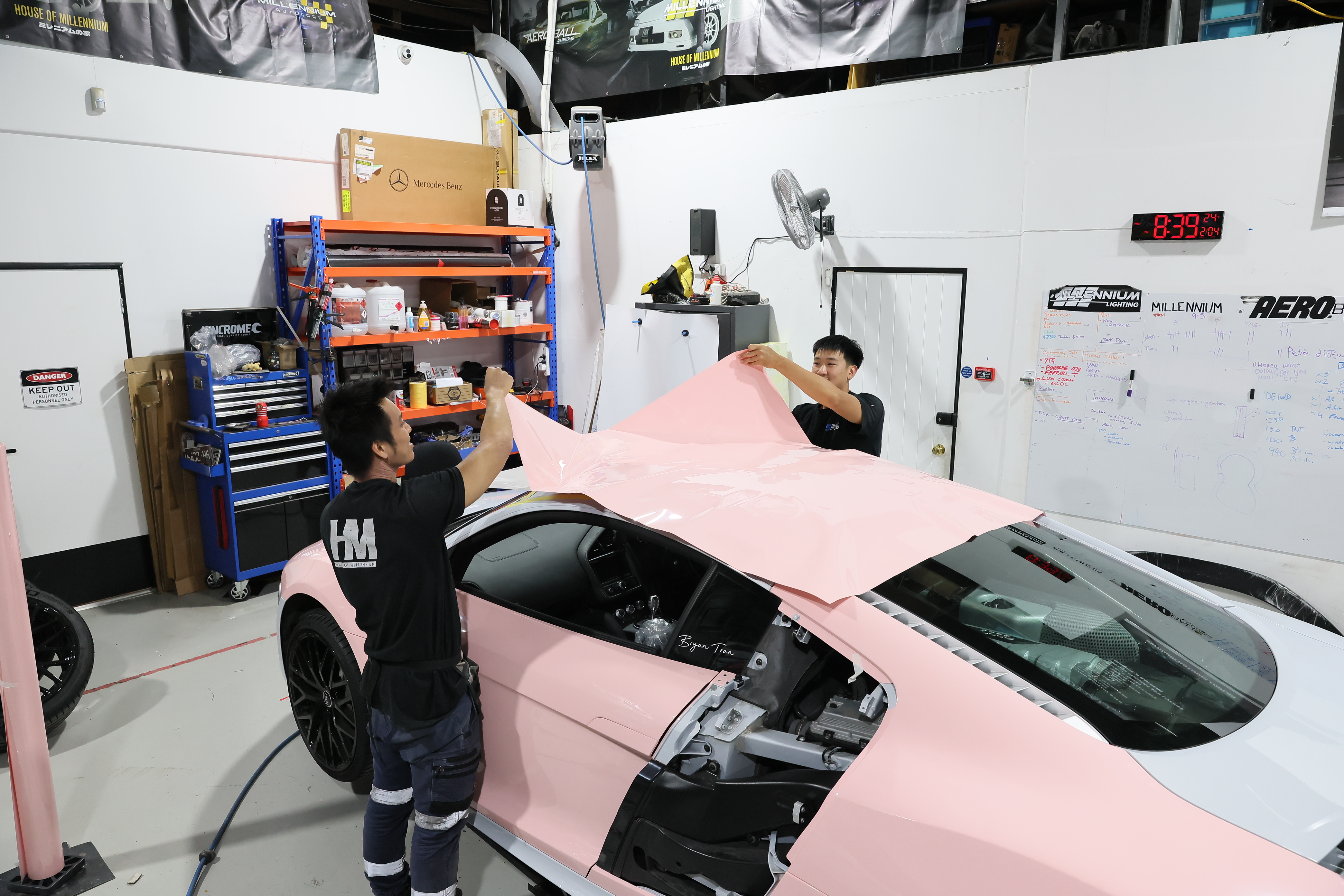
The roof is one of the most impactful panels you can wrap. It's visible from almost every angle, it changes the silhouette of the car, and a clean roof wrap in a contrasting colour is one of the best partial-wrap combinations you can do.
The process is similar to a bonnet — clean, measure, apply, post heat — but the edges are handled differently. Where a bonnet lets you fold around the lip, a roof tucks under the windscreen trims and into the roof gutters. Getting this right is what separates a clean job from one that lifts within months.
What You'll Need
- Vinyl wrap film (allow 20–30cm overhang on all sides)
- Heat gun
- Squeegee with felt edge
- Precision knife + fresh blades
- IPA solution (60:40 isopropyl alcohol to water)
- Microfibre cloths
- Plastic trim tool (for tucking under seals)
Step 1: Clean the Roof
Same as any panel — this is the most important step. Spray down the entire roof with IPA solution and wipe with a clean microfibre cloth. Do it twice.
Pay extra attention to the roof gutters on each side and the trim channels at the front and rear where the windscreen rubbers meet the roof. Wax and silicone collect in these areas and will prevent proper adhesion.
Let the panel dry fully before moving on.
Step 2: Measure and Cut Your Film
Measure the roof and cut your film with 20–30cm of overhang on all four sides. More than a bonnet — you need the extra length to work the film into the trim channels.
Leave the liner on and cut on a flat surface, not on the car.
Step 3: Position and Glass the Film
Remove the liner and position the film over the roof with a person on each side. Glass the film from the centre outward — your goal is to get it sitting flat with no wrinkles before you commit. Start in the middle and work toward each edge, letting the film settle naturally.
Don't press it down yet. At this stage you're just confirming the film is centred and lying smooth.
Step 4: Squeegee from Centre Out
Begin squeegeeing from the dead centre of the roof, working outward in all directions. Use overlapping strokes at a 45-degree angle, always pushing toward the edge — never back toward the centre.
Work methodically: centre, then front, then rear, then each side. Take your time on any raised seams, aerial mounts, or character lines across the roof.
Step 5: Handle the Front Edge — Tuck Under the Windscreen Trim
This is where the roof differs from a bonnet. The front edge of the film doesn't fold over a lip — it tucks under the rubber windscreen seal that runs along the top of the windscreen.
Warm the film with the heat gun so it's pliable. Use your plastic trim tool to gently lift the rubber seal away from the bodywork — just enough to slide the film underneath. Work slowly from the centre toward each corner, tucking the film in as you go. Press the rubber seal back down firmly over the top of the film.
The goal is for the film edge to sit completely hidden under the rubber. No visible cut line from the outside.
Step 6: Handle the Rear Edge — Tuck Under the Rear Windscreen Trim
Same process as the front, but the rear windscreen rubber is often tighter and the channel can be narrower. Work in smaller sections if needed.
Warm the film, lift the seal, tuck, press. Go from the centre out to each corner. Take extra care at the corners where the rubber changes direction — heat the film well and ease it around rather than forcing it.
Step 7: Handle the Side Edges — Into the Roof Gutters
The sides of the roof have gutters or channels that run front to back. The film tucks down into these channels and is held by the gutter itself, or by a trim piece that clips over the top.
Warm the film on each side, fold it down into the gutter channel, and use your squeegee to press it firmly against the channel walls. If there's a trim piece, lift it, tuck the film underneath, and clip it back into place.
Trim any excess film flush with the base of the gutter if needed.
Step 8: Post Heat
Post heat the entire roof — edges first, then the full surface. Focus on the front and rear tuck points and the gutter areas. This activates the adhesive and locks the film in place under the trims.
Run your finger along every edge after heating to confirm the film is seated firmly. Any area that hasn't bonded properly will lift over time.
Common Mistakes
Not tucking deep enough. Film that sits at the edge of the trim rather than under it will be pushed back by wind and weather. Push it in far enough that the trim holds it securely.
Skipping heat on the front corners. The film has to change direction at each corner of the windscreen. Without heat, it will crease or pull out of the tuck over time.
Cutting too much. Leave plenty of excess when you first cut your film — you need material to grip, pull, and tuck. Trim only after the film is fully applied and tucked into all edges.
Skipping post heat. Edges tucked under rubber seals need post heat to bond properly. Without it they'll lift within weeks.
Sunroofs
If your car has a sunroof, the film needs to be cut around the sunroof opening and the edges tucked under the sunroof seal — the same principle as the windscreen trims. Warm the film, lift the seal, tuck, and press.
Work slowly around the corners of the sunroof. These are compound curves and the film needs to be heated well to lay flat without lifting.